


Page 185 - CW E-Magazine (1-4-2025)
P. 185
Special Report


       hydrogen to diffuse out of the metal.  matter and are extracted alongside the
       If baking is not an option, then use of  oil and/or natural gas.  These gases
       lower strength steels and reducing the  readily  dissolve  in  water,  lower  the
       residual and applied stress are possible  pH by forming carbonic and sulphuric
       ways.  These may be the best options  acids, and can cause significant corrosion
       for circumstances that result in hydro-  or cracking of carbon steel – a common
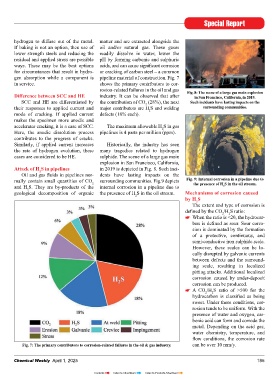
       gen absorption  while  a component  is   pipeline material of construction. Fig. 7
       in service.                       shows the primary contributors to cor-
                                         rosion-related failures in the oil and gas   Fig. 8: the scene of a large gas main explosion
       difference between Scc and HE     industry. It can be observed that after   in San Francisco, california, in 2019.
          SCC and HE are  differentiated  by  the contribution of CO  (28%), the next   Such incidents have lasting impacts on the
                                                           2
       their responses  to applied current and  major contributors are H S and welding   surrounding communities.
                                                            2
       mode  of  cracking.  If  applied  current  defects (18% each).
       makes the  specimen more anodic and
       accelerates cracking, it is a case of SCC.   The maximum allowable H S in gas
                                                                 2
       Here, the anodic dissolution process  pipelines is 4 parts per million (ppm).
       contributes to the progress  of  cracks.
       Similarly, if applied current increases   Historically, the industry  has seen
       the  rate  of  hydrogen  evolution,  these  many tragedies related to hydrogen
       cases are considered to be HE.    sulphide. The scene of a large gas main
                                         explosion in San Francisco, California,
       Attack of H S in pipelines        in 2019 is depicted in Fig. 8. Such inci-
                 2
          Oil and gas fluids in pipelines nor-  dents  have  lasting  impacts  on  the
       mally contain small quantities of CO 2   surrounding communities. Fig.9 depicts   Fig. 9: Internal corrosion in a pipeline due to
                                                                              the presence of H S in the oil stream.
       and H S. They are by-products of the  internal corrosion in a pipeline due to     2
            2
       geological decomposition of  organic  the presence of H S in the oil stream.  Mechanisms of corrosion caused
                                                       2
                                                                          by H S
                                                                               2
                                                                             The extent and type of corrosion is
                                                                          defined by the CO /H S ratio:
                                                                                            2
                                                                                         2
                                                                               When the ratio is <20, the hydrocar-
                                                                             bon is defined as sour. Sour corro-
                                                                             sion is dominated by the formation
                                                                             of  a  protective,  continuous,  and
                                                                             semi-conductive iron sulphide scale.
                                                                             However,  these  scales  can  be  lo-
                                                                             cally disrupted by galvanic currents
                                                                             between defects and the surround-
                                                                             ing scale, resulting in localized
                                                                             pitting attacks. Additional localized
                                                                             corrosion caused by under-deposit
                                                                             corrosion can be produced.
                                                                               A CO /H S  ratio  of  >500  for  the
                                                                                  2
                                                                                     2
                                                                             hydrocarbon  is  classified  as  being
                                                                             sweet. Under these conditions, cor-
                                                                             rosion tends to be uniform. With the
                                                                             presence of water and oxygen, car-
                                                                             bonic acid can form and corrode the
                                                                             metal. Depending on the acid gas,
                                                                             water chemistry, temperature,  and
                                                                             flow  conditions,  the  corrosion  rate
          Fig. 7: the primary contributors to corrosion-related failures in the oil & gas industry.  can be over 10 mm/y.


       Chemical Weekly  April 1, 2025                                                                  185


                                      Contents    Index to Advertisers    Index to Products Advertised

