
 27 February, 2024 18:06:29 IST
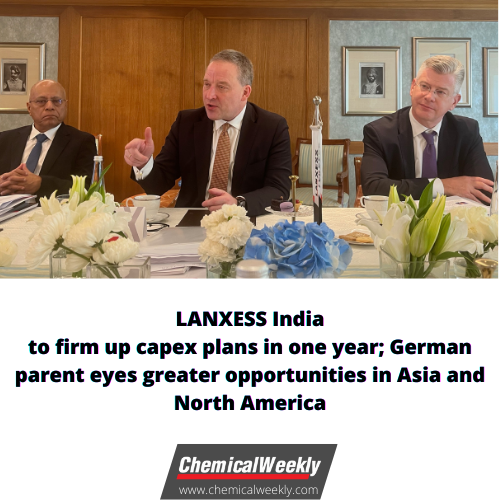
Cologne (Germany)-headquartered speciality chemicals company, LANXESS, which has undergone a radical transformation from a synthetic rubber focussed chemicals producer to one driven on chemistry-intensive performance chemicals, is planning to ramp up its operations in India, which currently spans two sites – one in Jhagadia (Gujarat) and the other at Nagda (Madhya Pradesh).
LANXESS CEO, Mr. Matthias Zachert, who was on his maiden visit to India since taking over as CEO, noted in a select media interaction that LANXESS India Pvt. Ltd., the wholly-owned subsidiary in India, has been mandated to draw up plans for expansion and capital expenditure. “I have opened the doors to the treasury and we expect the plans to be ready by next year,” he observed.
In a response to a poser by Chemical Weekly, he confirmed that future investments of LANXESS on a global basis will be focussed on North America and the growth markets of Asia, including India, while the company “will maintain and not shrink,” its capacities in Germany.
Sustainability as differentiator
Highlighting the challenging business conditions in the global chemical industry, and the pressures posed by commoditisation of many value chains, Mr. Zachert stressed that LANXESS is aiming to differentiate its offerings by highlighting its global supply capabilities, tailored to meet local market needs, and the sustainability advantages of its offerings. “In five years, we will be green in many of our offerings and the markets will recognise this,” he said.
LANXESS currently offers a limited range from its comprehensive portfolio of speciality chemicals under the ‘Scopeblue’ label, representing products that are sustainably advantaged compared to the rest of the market. These products have a carbon footprint that is less than half the industry standard and use a majority of sustainable raw materials, i.e., either bio-based or circular. The plan is to enhance this portfolio over the next 5-10 years by further leveraging bio-based raw materials and circular feedstock as well as ‘green’ chemical processes and technologies. This is being done in a staged manner, with an eventual aim of giving customers an option to choose between the ‘Scopeblue’ offerings and traditional products across the portfolio.
‘Unmatched demand weakness’
Dwelling on the challenges facing the global chemical industry, Mr. Zachert noted that the industry has been witness to unmatched demand weakness in 2023, with few exceptions – India being one. The lack of adequate demand recovery in China – the world’s largest chemical market, accounting for nearly half of global demand – has contributed in large measure to this, as have global uncertainties and rising protectionism. “A healthy growth in China’s chemical market is key to the health of the global chemical industry,” he noted.
LANXESS has not been immune to the challenges facing the global chemical industry, and has responded through portfolio reorganisation and cost savings. Over the last few years, the company has pivoted to focus on mid-size market opportunities – not large-volume petrochemical-based ones, such as synthetic rubbers. It has exited its joint venture with Saudi petroleum giant, Saudi Aramco (for synthetic rubbers), and, since then, built a portfolio of speciality chemicals catering to mid-size markets – through organic growth and acquisitions – with a clear aim of taking global leadership positions in markets where companies of its size or smaller operate.
LANXESS’ present portfolio now spans consumer protection (personal and home care), speciality additives (serving industries such as rubber, plastics, lubricants, etc.), advanced intermediates (serving 32 different industries) and inorganics (notably iron oxide pigments).
The geographical focus has also shifted to growth regions of Asia and North America, and a step-change is expected in the emphasis on India, which even today has all ten Business Units (BUs) represented. Production plants in Jhagadia serve multiple BUs, including Rhein Chemie (RC), Liquid Purification Technologies (LC) and Material Protection Products (PP), while the Nagda site mainly produces intermediates that go into fragrances and flavours. While LANXESS India reported sales of €316-mn in 2022, sales for 2023 is pegged a bit lower at €310-mn – indicative that the sharp reduction seen for the company as a whole has largely spared India.
With the Indian chemical market expected to grow at a CAGR of 5.9% for 2024-2026, compared to a world average growth of 3.6%, LANXESS is optimistic of its future even in the near-term.
Rhenodiv production plant expansion
In India, the RC BU, recently completed expansion of its Rhenodiv production plant at Jhagadia to meet the growing demands of tyre and rubber goods manufacturers in the Indian sub-continent and the rest of Asia. These tyre release agents are strictly water-based, solvent-free and free of volatile organic compounds (VOCs) and therefore, environmentally friendly.
The new production line features state-of-the-art equipment and technology, allowing LANXESS to produce high-quality technology tyre release agents more efficiently.
“India is an important region for us and this strategic milestone reflects our commitment towards meeting the growing demands of our valued customers in the region. The new facility not only amplifies our production capacity, but also showcases our faith in the immense potential of the Indian market,” said Mr. Zachert in a statement.
Speaking about the sustainability initiatives of the India operations, Mr. Zachert complimented the Indian team for its projects that has seen the substitution of coal by biomass at boilers at Jhagadia and Nagda; the use of green power at the Jhagadia site through power purchase agreements; and several process improvements at both sites. Thanks to these initiatives the India operations achieved 84% climate neutrality in India, and is aiming for a 150-kilotonnes of absolute CO2e reduction in 2024.