
Siddharth Kalpattu Shivakumar, Director Global Procurement Market Insights, explains why chemical buyers should treat weather signals as leading indicators of future costs. With a strong El Niño forecast for 2026-27, the biggest impact may emerge not immediately, but across 2027 through tighter supplies of palm oil, palm kernel oil, coconut oil, fatty alcohols, fatty acids, and glycerine. The article highlights how weather disruptions, plantation yields, biodiesel mandates, and logistics constraints such as Panama Canal draft restrictions can ripple through chemical supply chains months later. The message is clear: decision latency, not weather itself, is often the industry's biggest risk.
 Back
 5 October, 2026 14:42:38 IST
The weather has already priced your next contract

Other News

23 November, 2026 19:14:13 IST
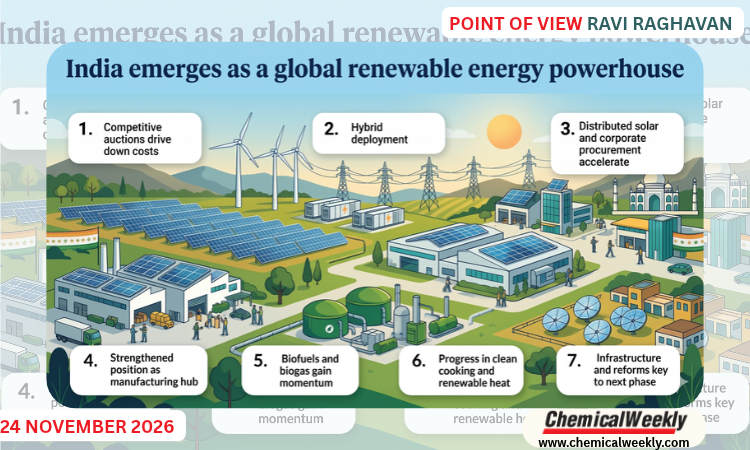
India emerges as a global renewable energy powerhouse
India has emerged as the world’s second-fastest-growing renewable energy (RE) market and the second-largest manufacturer of solar photovoltaic (PV) modules,...

★ EXCLUSIVE
20 November, 2026 16:30:17 IST
Commercial developments in the global chemical, energy and pharmaceutical industries
Adhithi Raghavan tracks major developments shaping the global chemicals, energy, and pharmaceutical sectors. Key highlights include China’s battery-material export controls...
PRINT EDITION




Nov 24, 2026
View Digital Issue
Download Issue
View Past Issues
Search For
Exhibitions & Conferences



Watch




OTHER PUBLICATIONS

DATABASES
