
 17 June, 2025 15:37:18 IST
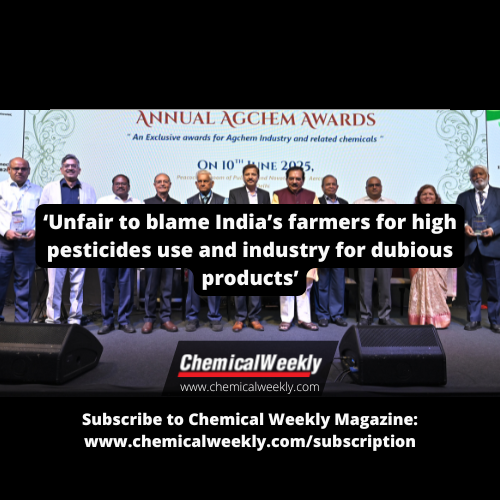
Developed countries, including Europe, Australia, and Japan, use pesticides at rates 4-8 times higher than India, yet, paradoxically, the global discourse, at the behest of foreign-funded NGOs and environmentalists, often targets India for high pesticide use. At the same time, allegations that 40-50% of pesticides sold in India are fake or sub-standard, are bogus, and designed to defame the Indian agrochemical industry and undermine its exports.
These were some observations made by Dr. Krishan Bir Chaudhary, President, Bharatiya Krishak Samaj and Member, High Level Committee on Agricultural Issues, Govt. of India, while speaking at the awards ceremony alongside the 22nd International Crop Science Conference & Exhibition (ICSCE 2025) organized by Pesticides Manufacturers and Formulators Association of India (PMFAI) on June 10-11, 2025 in New Delhi.
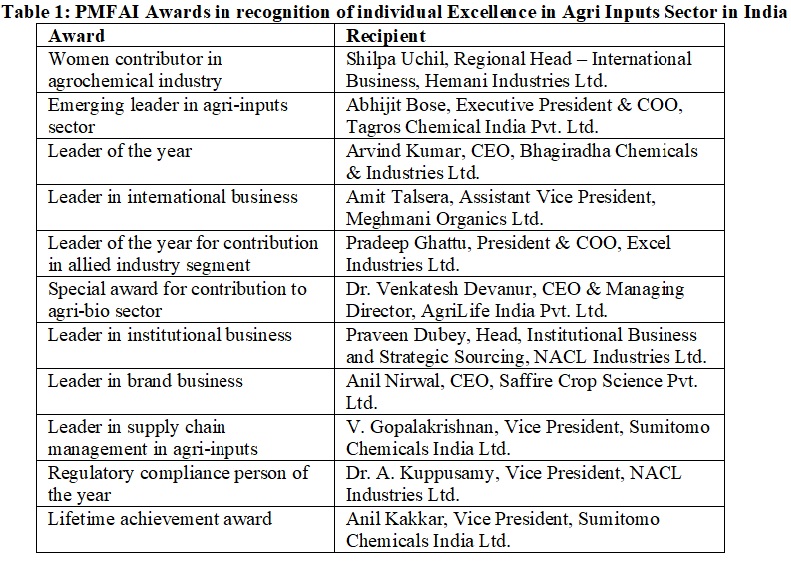
The two-day event saw the participation of 126 companies, who exhibited their product portfolios, and drew over 1,100 registered delegates, including international participants. The awards presented honoured individuals for their contributions to the growth of the Indian agri-inputs sector.
‘Valuable educational efforts by the agri-inputs industry’
Dr. Chaudhary praised Indian farmers for their profound knowledge and practical experience in pinpointing pest and disease issues and intervening effectively with precise timing and dosage. He also acknowledged the valuable educational efforts by the agri-inputs industry in teaching farmers safe and accurate pesticide application methods, including the importance of wearing protective gear.
Dr. Chaudhary cited data from a nationwide government initiative, which revealed that out of 175,000 samples collected across the country, only 1.81% were found sub-standard.
He also warned against efforts by various lobbies to ban generic pesticides, which effort, he said, is primarily intended to boost the import of readymade pesticide formulations into the country.
Dr. Chaudhary also expressed dismay over the appointment of incompetent officials to head pesticide review processes within the country. These officials, he noted, often possess no practical knowledge of agriculture, farming, or the significant impact banning generic pesticides would have on farmers.
‘Critical role in ensuring global food security’
In his inaugural address, Pradip Dave, President, PMFAI, emphasized the critical role of agri-inputs in ensuring global food security. He reiterated that with the ever-increasing global population, boosting food production is paramount, and India plays a vital role in this endeavour. Mr. Dave specifically highlighted the indispensable contribution of crop protection chemicals in enhancing both agricultural and horticultural output. Furthermore, he underscored the significant efforts of PMFAI and ICSCE in driving the development of India’s agrochemical sector and promoting exports from the country.
Deepak Shah, Chairman, SML Ltd. and Crop Care Federation of India (CCFI), noted the industry’s increasing focus on research and innovation.
Innovation and sustainability challenges
The event hosted a significant gathering of pesticide scientists and industry experts who delivered presentations on a variety of critical topics.
R.K. Goyal, Managing Director (South Asia), Verdesian Life Sciences LLC, stressed that the pursuit of innovation and sustainability has become both a necessity and a challenge. He noted that for companies in the bio-stimulant and plant nutrient sector, innovation demands heavy investments in research, validation, regulatory pathways, and farmer awareness. “Sustainability further compounds this challenge, calling for eco-friendly inputs, responsible manufacturing, and long-term impact assessment. Ultimately, the cost of innovation and sustainability is high, but so is the opportunity,” he stated.
Dr. A. Kuppusamy, Vice President & Head – Product Development, IPR & Regulatory Affairs, NACL Industries Ltd., spoke on the future of agrochemicals, and the need for balancing innovation with sustainability, while addressing regulatory challenges in India and globally.
Ms. Komal Shah Bhukhanwala, Director, SML Ltd., addressed the role of green chemistry in pesticide formulations.
The rise of biologicals
Dr. K.R.K. Reddy, Managing Director, Sri BioAesthetics Pvt. Ltd., explored the strategic imperatives for agrochemical players to integrate biologicals into their portfolios. He also highlighted key innovations, regulatory considerations, and collaboration models that can accelerate mainstreaming of biologicals. “As the global demand for sustainable agriculture grows, the industry’s ability to scale and deliver proven biological solutions will determine its relevance and leadership in the future of farming,” he stated.
Sushilkumar Bahuguna, Commercial Leader, IMEA, Momentive, focused on pioneering adjuvant technologies that empower growers to achieve “more with less”. He highlighted how Momentive’s advanced adjuvant solutions are helping growers around the globe enhance spray performance, soil health, and crop productivity in a sustainable way, while reducing waste and enhancing efficacy.
Mr. Shrikant Aherkar, Lead Scientist, Stepan Asia, Singapore, observed that many biological active ingredients are currently formulated as wettable powders, with little to no formulation technology behind them, which leads to poor performance and limited shelf-life. He gave the example of Oil Dispersions, which despite being one of the more challenging formulation types, bring several advantages, such as absence of water (promoting dormancy of cells & spores, and removing the need for preservation) and a potential for increased shelf-life compared to solid formulations.