
 17 September, 2024 16:04:36 IST
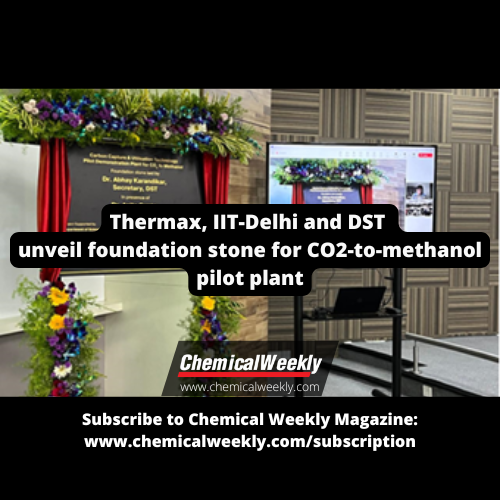
The foundation stone for a first of its kind CO2-to-methanol pilot plant with a capacity of 1.4 tons per day (tpd) was unveiled virtually by Dr. Abhay Karandikar, Secretary, Department of Science and Technology (DST), Government of India, at Thermax Limited premises in Pune, Maharashtra.
The unveiling was done in the presence of Dr. Anita Gupta, Adviser and Head, Dr. Neelima Alam, Associate Head, and other officers of the Climate, Energy and Sustainable Technology (CEST) division, DST. This project, supported by DST, is to be implemented in collaboration between the Indian Institute of Technology Delhi and Thermax, under public-private partnership (PPP) mode, with an overall project cost of around Rs. 31-crore.
Methanol is a low-carbon hydrogen carrier fuel produced from high ash coal, agricultural residue, CO2 from thermal power plants and natural gas. Although slightly lower in energy content than petrol and diesel, methanol can replace both these fuels in the transport sector (road, rail and marine), the energy sector (comprising DG sets, boilers, process heating modules, tractors, and commercial vehicles) and retail cooking. It is also a key starting material for the chemical sector.
Dr. Karandikar noted that the pilot plant would serve as a pioneering platform for the demonstration and advancement of indigenous Carbon Capture and Utilisation (CCU) technologies. He informed that NITI Aayog and the Ministry of Petroleum are working on a policy for the introduction of 15% methanol-blended diesel, which will help substantially reduce the import of crude oil.Dr. Gupta informed that this consortium project in PPP mode between IIT-Delhi and Thermax will serve as a first-of-its-kind CCU living lab, focussing on the development of new catalysts and processes for conversion of captured CO2 to chemicals from both pre-combustion and post-combustion processes, thereby, reducing the CO2 footprint. Additionally, a comprehensive techno-economic analysis will assess the feasibility and commercial viability of the CO2-to-methanol conversion process, demonstrating decarbonisation in the coal-based thermal sector, which accounts for approximately 30% of emissions.
She further stated that the findings will offer valuable insights for scaling up to commercial-scale CO2 to chemical plants. This will also help spearhead a groundbreaking initiative aimed at developing indigenous technologies and decarbonising hard-to-abate sectors.