2 September, 2025 14:22:29 IST
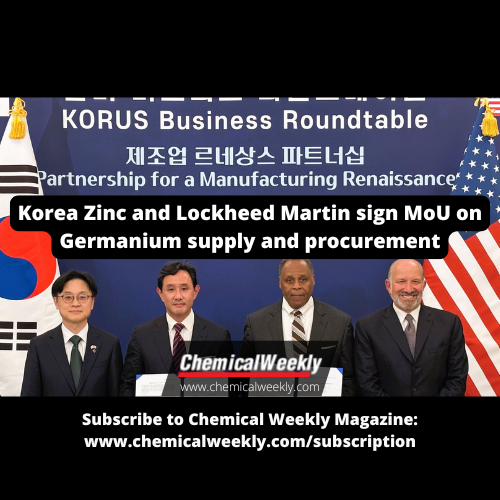
Korea Zinc plans to produce high-purity germanium using raw materials procured outside of China and provide the supply to Lockheed Martin
Korea Zinc, the world’s largest zinc smelter, signed a Memorandum of Understanding (MoU) with Lockheed Martin, the world's leading defence company, on August 25 for the supply and procurement of germanium and cooperation in the critical minerals supply chain. The MoU, pursued in line with ongoing Korea-US discussions on economic security cooperation, carries great significance as it aims at the establishment of a ‘China-free’ critical minerals supply chain, and marks the first successful case of Korea-US collaboration in the field of critical rare metals.
The MoU stipulates that Korea Zinc will supply Lockheed Martin with germanium smelted (covering the entire process from mining to production) outside of China, North Korea, Iran, and Russia, and that Lockheed Martin will pursue an offtake agreement, securing priority rights to procuring this output. Based on the MoU, the two companies will be beginning detailed discussions toward signing a long-term contract.
China dominance
Germanium is a key material used in the defence industry for night-vision goggles, thermal imaging cameras, and infrared detectors. It is also employed in the space industry for solar panels that power satellites. Additionally, it is widely used in advanced technology fields such as high-performance semiconductor devices, specialty gases for semiconductor processing, LEDs, fibre optic cables, and superconductors.
Currently, the world’s largest producer of germanium is China. According to KOTRA, as of 2021, 68% of the global refined germanium output of 140 tonnes originated from China. The US Geological Survey (USGS) has likewise identified China as the leading country among those that commercially produce germanium. With resource weaponisation trends intensifying, and growing concerns over the concentration of resource production in certain countries, the establishment of stable supply chains has emerged as an urgent international priority.
In line with the MoU, Korea Zinc plans to invest approximately KRW 140-bn in its Onsan Smelter in Ulsan to establish a new germanium plant. Following trial operations in 2027, the company aims to begin production in the first half of 2028, with plans to produce high-purity germanium dioxide (amount equivalent to approximately 10 tonnes of germanium metal). This development will position Korea Zinc as the only domestic producer of germanium in South Korea.