9 April, 2024 16:36:14 IST
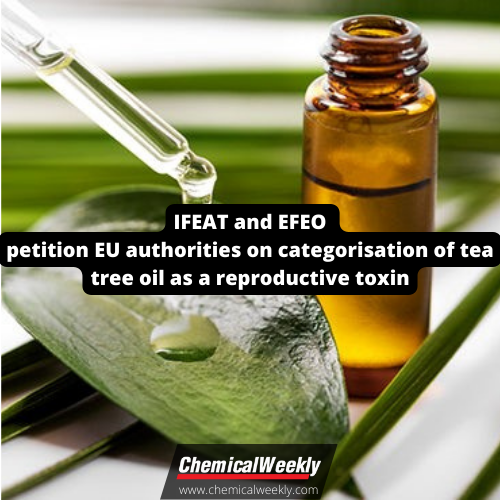
On December 7, 2023, the European Chemicals Agency (ECHA), which implements EU legislations like REACH and CLP (Classification, Labelling & Packaging), announced that its Risk Assessment Committee (RAC) had adopted eight opinions on proposals for harmonised classification and labelling (CLH). Three of these concern ingredients that may be used in cosmetic products, and include a CMR (carcinogenic, mutagenic or reprotoxic) classification for tea tree extracts and essential oils.
In March this year, the International Federation of Essential Oils and Aroma Trades Ltd (IFEAT) and the European Federation of Essential Oils (EFEO) made a joint submission to the EU Competent Authorities for REACH and CLP (CARACAL) on ECHA’s recommendation to classify tea tree oil as ‘Category 1B’ for reproductive effects.
‘Category 1B’ covers “Presumed human reproduction toxicants – largely based on animal studies.” The joint submission stressed the importance of human relevance being considered in detail before deciding on this classification.
Tea tree oil is an essential oil obtained by steam distillation of fresh leaves and twigs of Melaleuca alternifolia. It has been produced commercially since the beginning of the 20thcentury. In the EU it is principally used in cosmetics and traditional pharmaceuticals. More recently (since the mid-2000s), it has been used as a plant protection product.
The IFEAT-EFEO petition pointed out that if tea tree oil is classified as ‘Category 1B (fertility)’, trade in this product to the EU would collapse. “About 150-200 tonnes/year of tea tree oil is currently imported to the EU. Furthermore, any regulations against tea tree oil could have a knock-on effect for other essential oils, other naturally complex substances, as well as some of the major components of tea tree oil such as para-cymene and terpinolene,” the submission stated.
IFEAT and EFEO emphasised the over 100 years of safe use of the oil in the EU, and thousands of years of exposure to humans without any reported negative effect. “Until there is more mechanistic data available on tea tree oil itself, we have to rely on exposure data for human consumption. Since there is a broad human exposure to all constituents contained in tea tree oil from natural sources without any known negative effect, it is warranted that tea tree oil is labelled as ‘Category 2’ as there is clearly ‘doubt on human relevance’ – the key criterion to discriminate,” the submission stated.
Changing categorisation
The studies used to determine Category 1B classification must be supplemented with additional information related to human relevance, in part due to the fact that para-cymene, a component of tea tree oil, has a different mode of action in humans, contrasted to that in rats.
The Committee for Risk Assessment (RAC), responsible for preparing opinions related to the risks of substances to human health and the environment, noted that the mode of action of para-cymene certainly raises doubt on human relevance. Although being only a minor component of tea tree oil, the mode of action of para-cymene raises enough doubt for the entire oil. The CLP guidance document clearly does not require “proof” of mode of action, but mentions that as soon as mechanistic information raises doubt on human relevance, a classification in ‘Category 2’ may be more appropriate.