28 May, 2024 17:05:03 IST
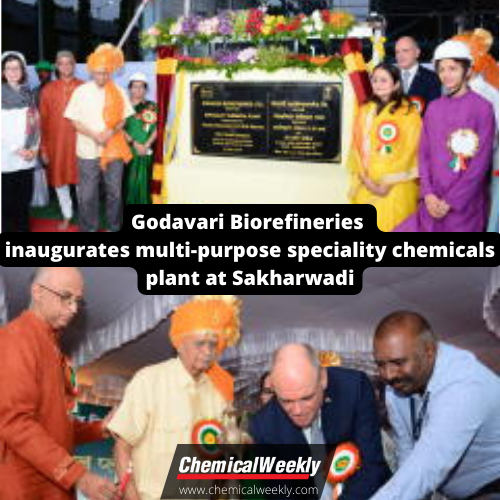
Godavari Biorefineries Ltd., a leading supplier of alcohol-based chemicals, formally inaugurated its new multi-purpose speciality chemicals plant, located at Sakharwadi, near Shirdi, in Maharashtra, on May 24, 2024.
The plant, which has been in operation for about six months, was formally inaugurated at the hands of Prof. M.M. Sharma, former Director, Institute of Chemical Technology, in the presence of the Consul General of the Kingdom of the Netherlands, Mr. Jong De Bart, and senior officials of GBL including Mr. Samir Somaiya, Chairman & Managing Director; Dr. Sangeeta Srivastava, Executive Director; Dr. (Mrs.) Lakshmi Kantam, Director, and Mr. Coen Faber, Director.
The new capacity will greatly augment the company’s ability to produced bio-based speciality chemicals, reduce imports of these and open new export markets. Among the products it will produce is ethyl vinyl ether (EVE), which is used as an intermediate in the manufacture of agrochemicals, aroma chemicals, pharmaceuticals and lube oil additives. The entire national requirement of this intermediate is currently imported, and demand is growing.
While the conventional process for making EVE (and other mono- and divinyl ethers), was developed by Reppe in the 1930s at BASF, by treating alcohols with acetylene under high temperatures and pressures, GBL’s novel route makes use of ethanol and acetaldehyde – both made from bio-based raw materials. This low-carbon footprint route to EVE, can be broadened (by choosing the appropriate alcohol) to enable the production of a range of vinyl ethers (e.g., methyl, butyl) – all bio-based and produced in safe and green processes, obviating the dangers of handling acetylene under pressure in concentrated form.
Acetaldehyde as a platform chemical
According to Prof. Sharma, acetaldehyde can be a ‘platform’ molecule for GBL. Produced from bio-based ethanol, it can be further derivatized through a variety of chemistries to produce a range of fine and speciality chemicals. “Acetaldehyde can be a kingpin for growth of GBL,” Prof. Sharma noted in his address at the inauguration.
On a more generic level, he stressed the importance of bio-transformations in the business of speciality chemicals, in particular the manufacture of optically active intermediates and drugs. “This is a weak area in India, but one which is seeing major breakthroughs,” Prof. Sharma added.
Transition away from commodity chemicals
According to Mr. Samir Somaiya, GBL’s growth strategy hinges around “the transition from making commodity chemicals (such as ethyl acetate) to value-added chemicals based on bio-based raw materials, using green chemistry.” These now account for about 50% of the company’s overall chemical sales, from under 10% just a couple of years ago.
The range of bio-based chemicals that GBL currently makes includes acetaldehyde, acetic acid, ethyl acetate, 1,3-butylene glycol, crotonaldehyde, 3-methyl-3-penten-2-one, and paraldehyde. There are ambitious plans to valorise bagasse – the fibrous waste left behind after extraction of cane crushing – to make high quality cellulose (which can be derivatized to make a range of eco-friendly polymers), lignin & derivatives, among others.
While the technologies needed for the new portfolio of products has been developed internally at GBL, the company is looking to partnerships with global leaders to drive product offtake. It has, for example, tied up with a major European company for the offtake of a bio-based ester used for coatings, and is supplying a key raw material that goes into making a well-known aroma chemical to another multinational.
“Our strategy as a Group is to use biomass to make foods, electricity, biochemicals and biofuels. This is the only planet that we have, and it is our duty to protect it. Often, this is an empty promise, but that is not so with us. We are building a company based on bio-resources, and biochemicals are a big part of this,” Mr. Somaiya added.