29 October, 2024 16:21:37 IST
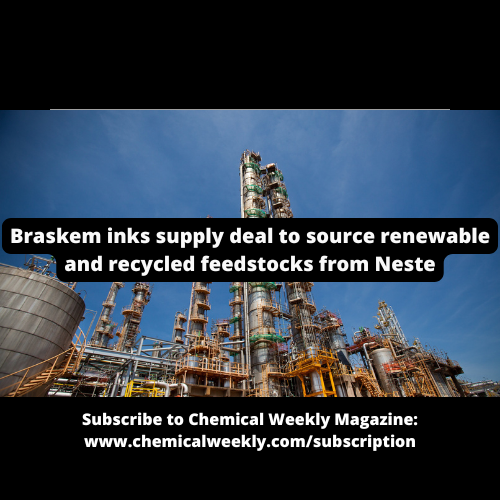
Brazilian petrochemicals major, Braskem, has announced plans to source sustainable feedstocks from Finland’s Neste to produce circular and bio-circular polymer resins and chemicals.
The companies recently reached an agreement for the supply of renewable and recycled feedstocks. Braskem products based on these feedstocks are expected to be available on the market starting from the fourth quarter of 2024. These products will be sold mainly in South America and included in Braskem’s Wenew product portfolio.
“We are introducing a new solution that will adhere to the industry’s high-quality standards while ensuring sustainability right from the start of the value chain. This partnership with Neste is a significant milestone in our journey towards a circular economy,” stated Ms. Fabiana Quiroga, Director of Circular Economy at Braskem in South America.
Braskem will sell polymer resins and chemicals made from Neste RE - the recycled feedstock, produced leveraging plastic waste via chemical recycling, and the renewable feedstock produced by processing renewable raw materials such as used cooking oil (UCO).
An ISCC PLUS (International Sustainability and Carbon Certification) certified mass balance approach will be applied to integrate the new feedstocks into Braskem’s existing processes.
By combining chemically recycled and renewable solutions, Braskem builds upon two of the most promising solutions to reduce the use of virgin feedstock and to promote sustainability in chemicals and plastics value chains.
Chemical recycling enables the recycling of those types of plastic waste that are otherwise difficult to recycle, for example multi-material or coloured plastics. In this sense, Neste’s chemically recycled feedstock can contribute to increasing recycling and therefore help reduce the amount of plastic waste entering the environment.
Neste’s renewable feedstock, on the other hand, can help reduce greenhouse gas (GHG) emissions when replacing fossil feedstock in the manufacturing of plastics and chemicals. It is produced using renewable raw materials such as waste and residue oils and fats like used cooking oil or residues from vegetable oil processing.