19 April, 2024 17:06:07 IST
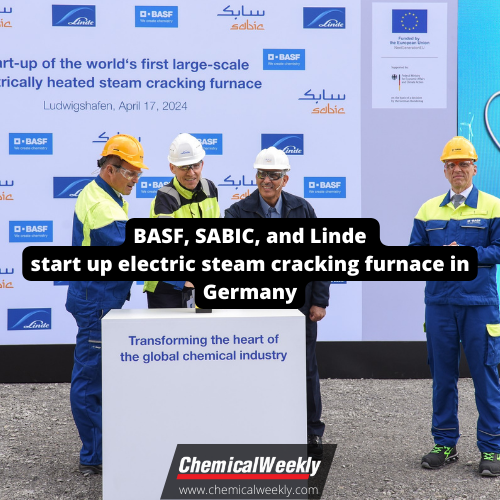
BASF, SABIC, and Linde have inaugurated the “world’s first” demonstration plant for large-scale electrically heated steam cracking furnaces. Following three years of development, engineering, and construction work, the regular operation of the demonstration plant is now ready to start at BASF’s Verbund site in Ludwigshafen, Germany. In March 2021 the three companies had signed a joint agreement to develop and demonstrate solutions for electrically heated steam cracking furnaces.
Steam crackers play a central role in the production of basic chemicals and require a significant amount of energy to break down hydrocarbons into olefins and aromatics. Typically, the reaction is conducted in furnaces at temperatures of about 850 degrees Celsius. Up to now, these temperatures have been reached by using conventional fuels. The demonstration plant aims to show that continuous olefin production is possible using electricity as a heat source. By using electricity from renewable sources, the new technology has the potential to reduce CO2 emissions of one of the most energy-intensive production processes in the chemical industry by at least 90% compared to technologies commonly used today.
The demonstration plant, which produces olefins, such as ethylene, propylene, and possibly also higher olefins from saturated hydrocarbon feedstock, is fully integrated into the existing steam crackers in Ludwigshafen. The upcoming operation serves the goal of gathering data and experiences about material behaviour and processes under commercial operating conditions for the final development of this innovative technology to industrial market maturity. In two separate demonstration furnaces, two different heating concepts will be tested. While in one furnace, direct heating applies an electric current directly to the cracking coils, in the second furnace, indirect heating uses radiative heat of heating elements placed around the coils.
The two electrically heated furnaces together process around 4 tons of hydrocarbon feedstock per hour and consume 6 megawatts of renewable energy.
To support the development of the novel furnace technology, the project was granted €14.8-mn by the German Federal Ministry for Economic Affairs and Climate Action under its “Decarbonisation in Industry” funding programme. The programme is supporting energy-intensive industries in Germany in their efforts to achieve carbon neutrality.
Based on the combined knowledge and intellectual property of the three parties collaborating to develop the new technologies, the demonstration unit in Ludwigshafen will be operated by BASF. Linde was responsible for the engineering, procurement, and construction of the plant. Linde will, in the future, commercialise the developed technologies under the new trademark Starbridge, enabling the petrochemical industry to decarbonise by replacing conventional fired technologies.