
 24 December, 2024 16:20:35 IST
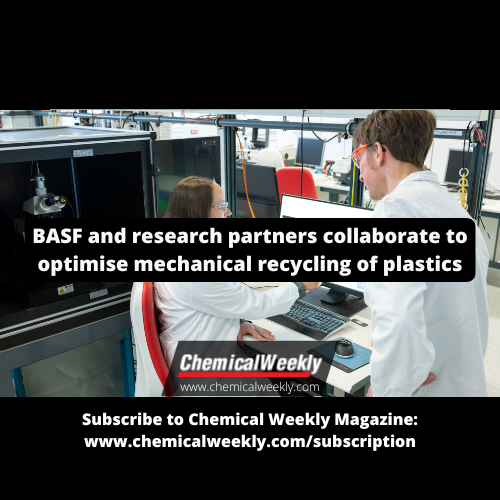
BASF has teamed up with Swiss lab instrumentation firm, Endress+Hauser, and German plastics firm, TechnoCompound, as well as the Universities of Bayreuth and Jena to study how the mechanical recycling of plastics can be improved. With funding from the German Federal Ministry of Education and Research (BMBF), the ‘SpecReK’ project aims to reliably and precisely identify the composition of plastic waste during the recycling process and thus improve the quality of recycled plastics. This will be achieved by combining state-of-the-art measuring techniques with artificial intelligence (AI).
The researchers are using spectroscopic methods which interpret how the material interacts with light to gain information about the chemical structure of the recycled plastics. The project partners want to use this data to determine in real time during processing which plastic grades, additives and contaminants are contained in the material. In a subsequent step, an AI algorithm will recognise patterns in the measurement data and recommend which additional components should be added or how the recycling process should be adapted to improve the quality of the recycled plastic output.
“We do not currently have the necessary analysis tools to determine during processing exactly which components are contained in the mechanically recycled plastics,” explained Dr. Bernhard von Vacano, head of the Plastics Circularity research programme at BASF. This information is needed, however, to evaluate and improve the quality of waste plastics. “This will enable us to use more mechanically recycled plastics to produce high-quality products and to make recycling processes more efficient and sustainable,” he added.
Circular economy for plastics
At present, most of the plastic waste that is sent for recycling is mechanically recycled. The waste is collected, sorted, crushed, cleaned and then melted. Depending on the input material and the degree of sorting, this melted material can contain different types of plastics, additives and contaminants. Therefore, the quality of the recycled output often varies and is not always sufficient to be transformed back into high-value plastic products.
“With the increasing demand for high-quality recycled materials, and given the current legal framework, it will be crucial to perfectly understand the material properties and composition of mechanically recycled plastic waste and to optimise the process. In this way, we will strengthen the circular economy,” Mr. von Vacano said.
In this joint project, BASF is cooperating with Endress+Hauser, TechnoCompound, the University of Bayreuth and Friedrich Schiller University Jena. The total project volume is €2.2-mn, with two-thirds financed by BMBF funds from its quantum systems research program and one-third financed by the project partners.