31 March, 2026 17:14:56 IST
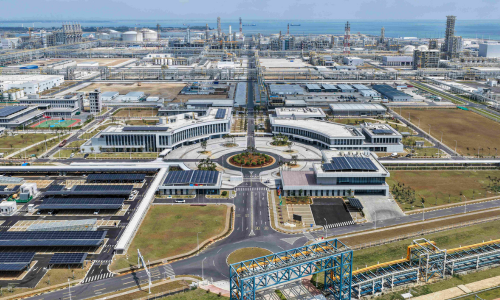
German chemicals giant, BASF, celebrated the official inauguration of its newly built Verbund site in Zhanjiang, Guangdong Province in southern China on March 26, 2026.
Covering an area of around four square kilometres, the Zhanjiang site will produce a diversified portfolio that includes basic chemicals, intermediates and speciality chemicals for the transportation, consumer goods, electronics, home care and personal care industries.
“Zhanjiang shows what the future of chemistry looks like: efficient, digital and sustainable by design. The site showcases a smart integrated Verbund structure on an industrial scale,” said Dr. Markus Kamieth, CEO of BASF, at the ceremony attended by representatives from government, customers, business partners and employees. “This investment shows confidence in the world’s largest chemical market in the long run,” he added.
The majority of the products manufactured in Zhanjiang will directly serve customers in China, fully aligning with BASF’s global “local‑for‑local” approach. The project was completed on schedule and well below the original budget, with an investment of around €8.7-bn, the company informed.
By using Verbund integration, process innovations and renewable energy, CO₂ emissions at the site can be reduced by up to 50 percent compared with a conventional petrochemical site. Long-term green power purchase agreements and investments in an offshore wind farm enable the site’s electricity supply to be 100 percent renewable.
“Innovative technologies are also being used for the steam cracker – the starting point of various value chains at the Verbund site,” informed Dr. Stephan Kothrade, member of the Board and Chief Technology Officer of BASF, who is responsible for the Asia Pacific region. It has a capacity of 1 million tons of ethylene per year and is the world’s first cracker equipped with main compressors (e-drives) powered by 100 percent renewable energy, supporting the production of high-quality, low-CO2 products. The world-scale flex-feed steam cracker is designed to process multiple types of feedstocks, such as naphtha and butane.
In the past few months, BASF has successfully started up 18 plants, 32 production lines, and is now producing more than 70 products.
BASF announced the Zhanjiang project in 2018 and laid the foundation stone the following year. The first production plant to begin operation at the Zhanjiang site was for engineering plastics in 2022; it was followed by a thermoplastic polyurethane plant in 2024. At the turn of 2025/2026, BASF began production in the first value chains in the Verbund and successfully ramped up the steam cracker in record time.
The Zhanjiang site is BASF’s seventh Verbund site worldwide and the third largest after Ludwigshafen, Germany, and Antwerp, Belgium. It will be operated solely under BASF’s responsibility.