13 February, 2024 14:19:53 IST
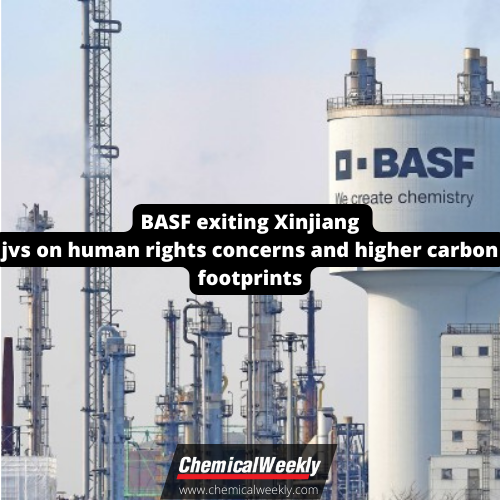
German chemicals giant BASF has announced that it will divest its stake in its two joint ventures in Xinjiang, after media reports about alleged “gross abuse” of Uyghurs by employees of the jvs - BASF Markor Chemical Manufacturing and Markor Meiou Chemical, both based in Korla.
Uyghurs - a mostly Muslim, Turkic-speaking ethnic group - live in China’s northwestern province of Xinjiang and western media reports, have over the past, reported numerous human rights violations perpetrated by the Chinese government on the group.
In a statement, BASF said that while “regular due diligence measures including internal and external audits have not found any evidence of human rights violations in the two jvs”, the recent reports “indicate activities inconsistent with BASF’s values”.
“Consequently, BASF will accelerate the ongoing process to divest its shares in the two joint ventures in Korla, subject to negotiations and required approvals of the relevant authorities. It is important to note that, also in the context of the public reports, BASF has no indication that employees of the two joint ventures in Korla were involved in human rights violations. The most recent reports relate to BASF’s joint venture partner, in which BASF does not have a stake,” it concluded.
Earlier, a group of politicians from around the world urged BASF to withdraw from Xinjiang following recent reports in German media that people employed by the jvs accompanied Chinese state officials in 2018 and 2019 on home visits to Uyghur households as part of a government initiative that human rights groups have said is used to spy on people and indoctrinate them.
BASF frontloaded the announcement with concerns about the carbon footprint of the 1,4-butanediol (BDO) produced at the facilities, which uses coal as a base raw material and a source of energy. The company said the exercise is part of its move to customise its global portfolio of BDO and affiliated downstream products to provide “competitive low-PCF (product carbon footprint) offerings”.
“As part of BASF’s global strategy for 1,4-butanediol (BDO), BASF has assessed the market environment and PCFs of BDO and its downstream products from different production sites worldwide. BDO value chains are under increased competitive pressure and characterised by global overcapacities. Furthermore, carbide-based BDO and polytetrahydrofuran produced in Korla have a significantly higher PCF due to the use of coal as a base raw material and the high energy intensity of the production process,” a company statement explained.
In the statement announcing the divesting, BASF noted that its presence in China, which accounts for around half of the world’s chemical production, ‘remains otherwise unchanged’.