17 July, 2026 16:20:43 IST
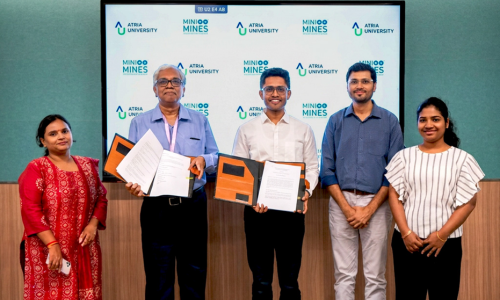
Bengaluru-based Atria University and MiniMines Cleantech Solutions have partnered to establish the MiniMines-AU Laboratory for Sustainable Resource Recovery, a facility combining artificial intelligence and synthetic biology to recover critical metals from spent lithium-ion batteries.
Based at Atria University’s campus, the laboratory will draw on the university’s expertise in artificial intelligence and life sciences alongside MiniMines’ capabilities in lithium-ion battery recycling, critical mineral recovery and process commercialisation. The partners said the collaboration aligns with the government’s BioE3 (Biotechnology for Economy, Environment and Employment) policy promoting bio-based manufacturing and circular-economy solutions, and its National Critical Minerals Mission aimed at building self-reliance in the critical minerals sector.
The laboratory’s first phase will focus on recovering lithium from used lithium iron phosphate (LFP) batteries, targeting lithium recovery while preserving high-grade iron phosphate, which conventional chemical recycling often degrades. The facility will cover the full research cycle, from microbial cultivation and bioleaching experiments to laboratory-scale validation, supported by researchers, faculty and students.
Dr. Madhavan Nair Rajeevan, Vice-Chancellor of Atria University, said the partnership showed “how industry and academia can build strategic technologies together by combining the university’s strengths in artificial intelligence and life sciences with an industry partner’s real-world expertise” to help translate research into deployable solutions.
Mr. Arvind Bhardwaj, Chief Technology Officer of MiniMines, said India’s clean-energy transition would depend on securing a sustainable domestic supply of critical minerals, and that the company saw resource recovery being driven by a combination of advanced metallurgy, artificial intelligence and biological innovation.
The laboratory operates within Atria University’s ‘SynBioAI’ initiative, an AI-guided synthetic biology hub whose platform uses specialised AI models to help scientists engineer high-performing microbial strains faster. The partnership will advance microbial processing as a complementary approach to conventional recycling, aiming to reduce chemical and energy intensity while recovering metals from complex or low-grade waste. MiniMines will evaluate process scalability, economic viability and industrial implementation to help integrate successful lab innovations into commercial recycling operations.
MiniMines has separately signed a Rs. 350-crore MoU with the Government of Karnataka to establish a Giga Critical Minerals Refining Complex with a planned first-phase capacity of 15,000-mtpa.