
 12 March, 2024 15:47:44 IST
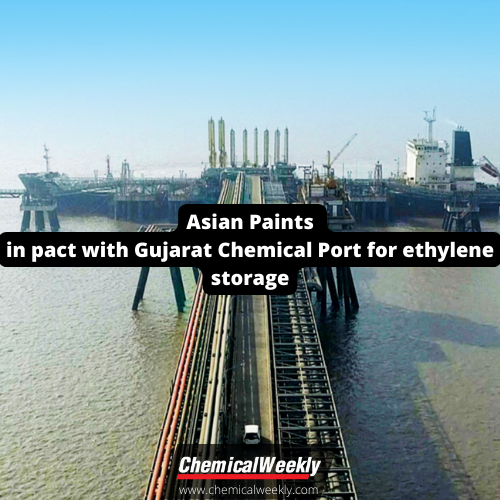
Asian Paints (Polymers) Pvt. Ltd. (APPPL), a wholly-owned subsidiary of Asian Paints, has entered into agreements with Gujarat Chemical Port Ltd. (GCPL) for setting up an ethylene storage and handling facility at Dahej, Gujarat.
Ethylene is a key raw material for the manufacture of vinyl acetate monomer (VAM) and vinyl acetate ethylene emulsions (VAE). Asian Paints, it may be recalled, had earlier announced plans to set up manufacturing facilities for VAM and VAE emulsions at Dahej, at an estimated cost of Rs. 2,100-crore.
Located in Dahej, Gujarat, the facility will manufacture VAE and VAM, at an estimated cost of Rs. 2,100 crore. The installed capacities planned are 100-ktpa for VAM, based on technology licensed from KBR (USA), and 150-ktpa for VAE.
APPPL will give a security deposit of Rs. 460-crore to GCPL, which will be refunded over the course of 17-18 years, as a part of the agreement with GCPL.
GCPL, a joint venture promoted by the Gujarat Government, operates a commercial port in Dahej. It also owns and operates a network of shore-based tank farm installations used for the receipt, storage, and handling of bulk chemicals.
VAE resins have been in used in the paints industry for more than 50 years, but till the 1990s remained a niche. Some of this had to do with the fact that VAE plants were more expensive to build, compared to those to make acrylic resins, and price differentials on the raw materials to make these two competing resin chemistries were not enough to offset this capex disadvantage. What has changed this dynamic, however, in the last decade or so is tightening regulations concerning emissions of volatile organic compounds (VOCs) from several end-user industries for these synthetic resins. The drive to low-VOC and water-based systems originated in the west, but is now pervasive across much of the world. In the view of most experts, this trend will intensify in the years ahead and India too will not be an exception to it.
VAE copolymers – produced through dispersion polymerisation of the ‘hard monomer’, VAM, and ‘soft’, hydrophobic monomer, ethylene – are inherently low-VOC-capable due to the fact that ethylene is directly incorporated into the polymer backbone, making it an efficient ‘internal’ plasticiser. Their excellent coalescing properties means minimal quantities of solvents are needed for film-forming, making them an excellent choice particularly for low-VOC architectural coatings.
About 0.72-tonnes of acetic acid and 0.40-tonnes of ethylene are required to produce 1-tonne of VAM, which means the proposed VAM plant will need about 72-ktpa of acetic acid and 40-ktpa of ethylene. In addition, the VAE plant will need an additional 30-ktpa of ethylene. India’s VAM demand is currently fully met by imports, which in FY22 was about 310-kt.